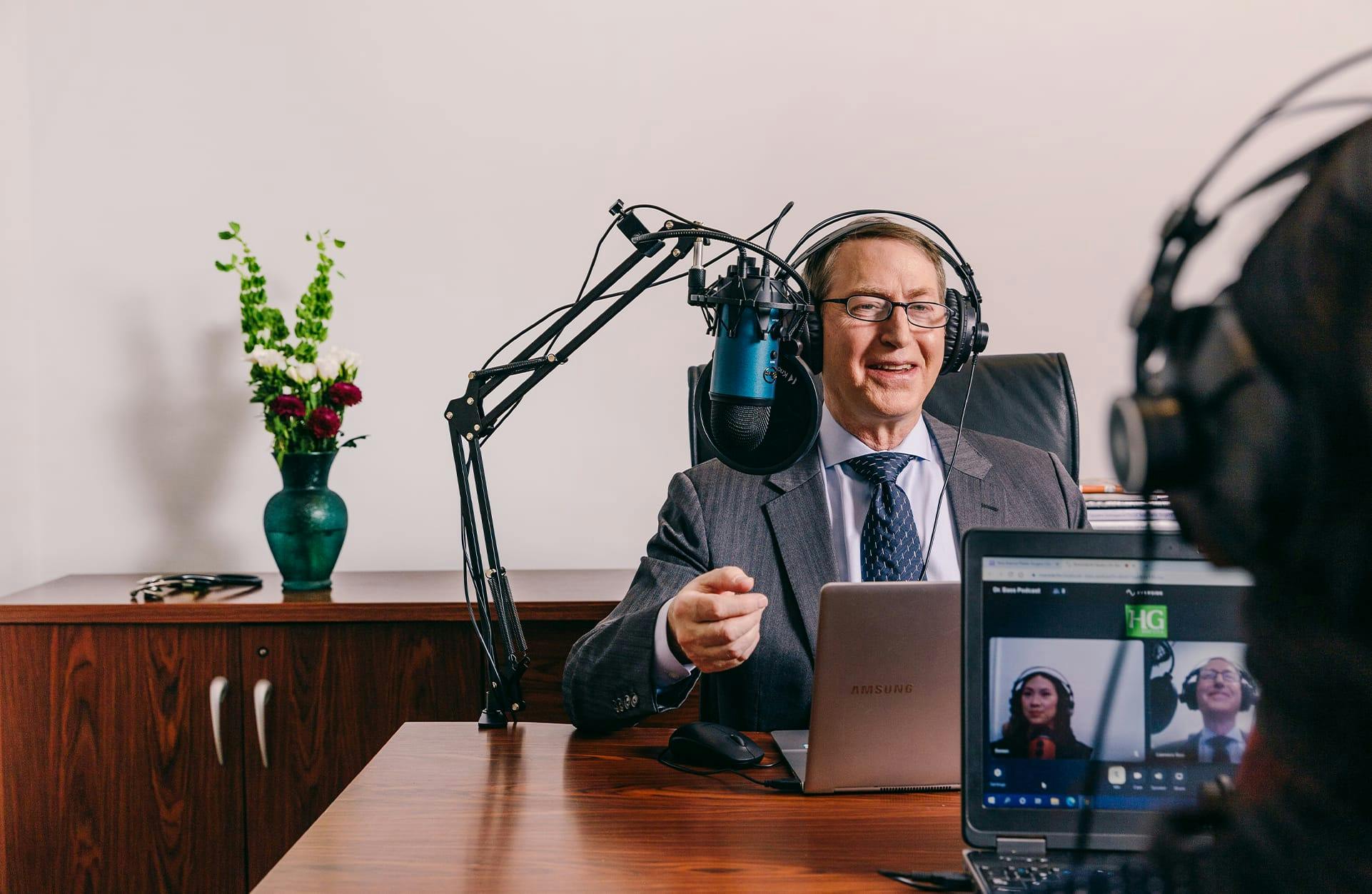
Listen to the Podcast
Facial appearance carries some of the strongest signals of gender, and small, precise changes can shift how a face reads to the world.
Dr. Lawrence Bass and returning guest Dr. Jason Bloom, co-director of the Facial Plastic and Reconstructive Surgery Fellowship at the University of Pennsylvania, walk through the standard menu of facial feminization and masculinization work: brow shape, nasal bridge and tip, forehead slope, cheek volume, and jaw and chin contour. They compare implants, fat grafting, and fillers for each area, and explain why male-to-female changes tend to be reductive while female-to-male changes tend to be additive.
Dr. Bloom shares how neuromodulators and fillers let people preview a look and adjust brow height or cheek volume with real precision, without surgery or anesthesia. Insurance coverage, cost, and the reality that this work is ongoing rather than one-and-done round out the conversation.
The takeaway: there is no single template for a masculine or feminine face, and the right surgeon listens to what a person wants rather than repeating one signature style.
About Dr. Jason Bloom
Dr. Jason Bloom is a facial plastic surgeon in Bryn Mawr, Pennsylvania, and co-director of the Facial Plastic and Reconstructive Surgery Fellowship at the University of Pennsylvania. He completed his fellowship at New York University and Manhattan Eye, Ear and Throat Hospital.
About Dr. Lawrence Bass
Innovator. Industry veteran. In-demand Park Avenue board certified plastic surgeon, Dr. Lawrence Bass is a true master of his craft, not only in the OR but as an industry pioneer in the development and evaluation of new aesthetic technologies. With locations in both Manhattan (on Park Avenue between 62nd and 63rd Streets) and in Great Neck, Long Island, Dr. Bass has earned his reputation as the plastic surgeon for the most discerning patients in NYC and beyond.
To learn more, visit the Bass Plastic Surgery website or follow the team on Instagram @drbassnyc
Subscribe to the Park Avenue Plastic Surgery Class newsletter to be notified of new episodes & receive exclusive invitations, offers, and information from Dr. Bass.
Transcript
Summer Hardy (00:01):
Welcome to Park Avenue Plastic Surgery Class, the podcast where we explore controversies and breaking issues in plastic surgery. I'm your co-host, Summer Hardy, a clinical assistant at Bass Plastic Surgery in New York City. I'm excited to be here with Dr. Lawrence Bass, Park Avenue plastic surgeon, educator and technology innovator. The title of today's episode is Injectable Fillers and Gender Affirmation. We've talked about fillers before. Fill me in on this filler topic, Dr. Bass. What do fillers have to do with gender affirmation?
Dr. Lawrence Bass (00:32):
Well, let's start with the basic definition. Gender affirmation or transitioning when it comes to the face, what does that mean? So it's taking features that you were born with that may resemble one gender and creating features that are more identifiable to the patient and to the public as a different gender.
Summer Hardy (00:57):
Okay. So we're going to talk about the ins and outs of gender affirmation or transitioning for the face. What's the focus of this episode?
Dr. Lawrence Bass (01:06):
This is a review of what the standard approach in the facial aspects of affirmation are. We're going to talk about some cutting edge things to improve customization and precision in creating the right gender look because again, it's not literally binary. And so we're talking about trends, not the specific needs or preferences of any individual patient. That's going to vary from person to person, of course. Everyone's face is unique and everyone's preferences are different. To join me in this discussion, I've invited Dr. Jason Plume back to the podcast and he's been a guest on some of the most critical topics in facial plastic surgery on our podcast. And he's also been the guest on a number of the top streaming episodes of the podcast. Dr. Bloom is a facial plastic surgeon in Bryn Mawr, Pennsylvania. He completed his residency in ear, nose and throat, what medically we call otorhinolaryngology, head and neck surgery at University of Pennsylvania, and his facial plastic surgery fellowship at New York University and Manhattan Eye Ear and Throat Hospital.
(02:35):
And that's also where I completed my plastic surgery training so we share some common academic and primatur. Dr. Bloom's currently the co-director of the Facial Plastic and Reconstructive Surgery Fellowship Program at the University of Pennsylvania. Dr. Bloom, welcome back.
Dr. Jason Bloom (02:55):
Well, thank you for having me. It's always nice to chat with you. I get to see you at some meetings and some academic things throughout the year. So it's certainly nice to be back and thanks again for having me.
Summer Hardy (03:09):
Welcome, Dr. Bloom. Let's kick things off with an overview of what kinds of surgical procedures are done on the face as part of gender affirmation.
Dr. Jason Bloom (03:17):
So some of the surgical procedures I would say more commonly are what's typically known as FFS surgery or facial feminization surgery. These are really kind of procedures in general that can be used to reshape the forehead, brows, nose, cheeks and jawline, as well as while it's not a facial surgery, something to minimize the appearance of the Adams Apple in a male to female kind of transition. These are a lot of the basic kind of surgeries that are done to achieve, for example, a more feminine appearance. It's important to consider things that the patient may want. For example, a typical more masculine brow is flatter and less arched, but a more feminine look may go for a more laterally arched brow. When we're talking about the nose, it could be a more masculine nose has a straighter, more projecting bridge versus a more feminine delicate nose has maybe a soft slope to it with a little bit more upturn and narrowness.
(04:44):
When we talk about forehead, male more masculine foreheads are typically a little bit more broad and flat, whereas a more feminine forehead tends to have more of a slope to the aspect where it reaches the supraorbital rim above the brows. And then more feminine cheeks, for example, there are cheek implants and fillers and things that can be done such as fat when we're talking surgically to give more kind of plump rounded cheeks with more volume out laterally and less anteriorly in the face. And then finally the jaw, and we can talk about the chin, whereas masculine jaws tend to be more angular, wide in the posterior aspect of the jaw. And then the chin also has certain aspects of it which lend to a more masculine or feminine chin. So a more feminine chin is more narrow anteriorly with we like to keep the volume within the nasal base and then a more masculine jaw or chin tends to be more square with more of the volume centered within the oral commissures.
(06:14):
So all these things we look at and surgeries can go in all these different directions to either masculinize or feminize a face depending on what the patient wants.
Dr. Lawrence Bass (06:29):
So that's really interesting. And I think there's some history here as well because certain things about facial shape, the way it's been perceived by gender historically were not as precise as the analysis that's been made today of gender differences. And so some of the surgery for transgender people decades ago created a very stylized look that was recognizable not as male or female but as trans. And surgery has evolved a great deal, become much, much better to really create a much more natural look to the face with any of these gender-affirming techniques.
Dr. Jason Bloom (07:21):
I think even so much so that as you know, in plastic surgery in the plastic surgery community, there are now accredited fellowships within plastic surgery and actually facial plastic surgery where you can do full fellowships just specializing in the area. In the facial plastic surgery fellowships, there are to really specialize in the face and then full body gender affirmation fellowships within the plastic surgery community.
Dr. Lawrence Bass (07:57):
Yeah, that's a good point. And you brought up an issue about shaping on people's faces and you talked about bone surgery and there's surgery with implants and there's also surgery with fat. You mentioned that. And that's going to feed into our main subject of discussion in this podcast episode. So how do you think about implants versus fat in terms of what they're able to do in the face? And we'll go from there and look at injectables, which is our main subject today.
Dr. Jason Bloom (08:32):
It's very interesting. I think there are places where implants do very well and they are by go - to. For example, where you have a bony buttress, for example, the chin, some people want a long-lasting improvement and I think a chin implant works very well in those cases. I don't like to put fat or something in the soft tissue that is less shapely and more amorphous when it's not on the bone. So I personally don't use fat to augment the chin. But when we're talking about the mid-face and the cheek, I can't tell you is probably since my fellowship was the last time I put in a true cheek implant and I tend to go with either filler or fat because you can inject those at multi-different levels, both on the bone and in some of the soft tissue to give volume and it works really well in those cases.
(09:44):
So I think it really depends on the actual procedure performed and the area that they're looking to get improvement.
Dr. Lawrence Bass (09:56):
Well, as you said, you get more durability, sort of a permanent change with bone surgery or with an implant, but things like creating a female cheek, which is supposed to be very curvy, very soft, not have a highly sculpted look, things like fat are probably a better choice for doing something like that because it has that soft round appearance that you're trying to create. And from there you can think about how much precision do you have? How much longevity do you have? How much predictability or control over both size, shape, position and longevity? And that's where fat sometimes lets us stay.
Dr. Jason Bloom (10:52):
If I could make one other comment about just the surgical procedures, I think in general, the majority of male to female gender affirmations like procedures are reductive in nature. You're going from a more kind of a square chin to a narrow chin. You're going from you're trying to push the forehead back, you're trying to give some more slope to the nose. A lot of the procedures are reductive. It's much harder to achieve that kind of result in a non-surgical manner. And then we think of the female to male transition or gender affirmation is more additive. So it's a lot easier to achieve some of these results when we're adding volume or structure or support rather than... And so there is a little bit easier option. We have more options in a non-surgical and surgical manner versus when we're looking at the male to female transition, it's a lot harder to achieve that without surgical procedures.
Summer Hardy (12:13):
This has been a really interesting discussion. There are a lot of small details I hadn't considered before. How much customization is there? Are surgeons just producing cookie cutter faces?
Dr. Jason Bloom (12:24):
Yeah. I mean, I think now our techniques are so much better as Dr. Bass was saying. Our techniques are better. We're able to not only achieve better, more natural results, but now we have other things in our armamentarium to perform small tweaks on the patients to create more to help us do these procedures. And a lot of the procedures can be performed without surgery. So if we're looking to go from a more masculine flat brow to a more feminized look and get the brow elevated, you can use neuromodulator to do that and really shape the brow and position the brow peak where you want in our offices using neuromodulators or give more volume to someone's lips with fillers. There's a lot more things we have at our fingertips now that allow us to produce these more precise changes.
Dr. Lawrence Bass (13:39):
So I'm going to come back to that, but I just hear Summer's question and want to add a comment. I think people are trying to harmonize features, look at everyone's individual face when they do gender affirmation surgery. But at the same time, there is this standard suite of techniques working on the brow, working on the nose, working on the cheeks, the jaw, the chin. And there are limits to the precision that that surgery can give you the control you have over nuances of shape because you're dealing with bone, you're working with power tools, and you can do a lot of things predictably. And surgeons have things that work well in their hands so they do have a style or a face to an extent, even though they do try to adjust those techniques for the individual facial features to create harmony in the new gender.
(14:55):
Dr. Bloom and I agreed to do this episode when we were talking at a meeting about the use of injectables in transgender patients. So Dr. Bloom, can you tell me a little bit about why and how you started using injectables compared to surgery or fat grafting?
Dr. Jason Bloom (15:14):
Yeah, I mean that's a good question. As a faculty at the University of Pennsylvania, I get to work with the facial plastics residents and fellows, the ENT residents and fellows, as well as the dermatology residents and plastic surgery residents. And one of the former residents now attendings came to me and said, "Man, I see a lot of patients seeking gender affirmation procedures." And he was a dermatologist and he is a dermatologist. And he said, "It would be so great to create a multidisciplinary clinic for the residents where you can come in and lecture us and teach us about the differences between the genders and how we can use injectables to help these patients sometimes as almost like a trial run in some cases to see what it would be like to have a little bit more volume in the lips or a little bit more volume in the cheeks without having to undergo surgery.
(16:21):
And that discussion and after multiple meetings and things like that, we decided that this would be such a great offering to the community. And just with our connections through the different injectables companies, we could have them sponsor it and it's great teaching for the residents. And now I've taken this idea and not only have the residency clinics, but we do it in our office. I've written multiple publications about this and I have people coming to see me from sometimes all over for even injectables.
Dr. Lawrence Bass (17:02):
So that's great. And part of the reason I got so excited when you mentioned you were doing this was because it hit a lot of the same concerns and excitement that I've had in this regard. So now that you've gotten a lot of experience and written articles, share a little bit about your view on what some of the advantages and disadvantages of injectables are compared to surgical techniques that are currently available.
Dr. Jason Bloom (17:34):
Sure. So I think some of the advantages are certainly it's not a surgical procedure. We can do this in our office and allow patients to see immediate results of a lot of these procedures with very little to no downtime. And a lot of patients just in general, whether we're going a true a gender affirmation procedure or any kind of surgical procedure in general, patients are, they're scared of surgery, they're scared of anesthesia, things like that. And it's now injectables, whether you're using neuromodulators or fillers are so widely accepted at this point that patients may not understand or know like, "Hey, we're going to do a facial feminization surgery," but they know what Botox is and they know that fillers give volume and plump tissue. So it's a little bit more familiar with a lot of our patients. Additionally, as you mentioned, the precision is extremely, extremely high.
(18:50):
I can almost sometimes pinpoint where we want the brow height to be or the brow peak to be using neuromodulators. Obviously the disadvantages are they go away. So whether you're using a neuromodulator or a filler, they're very temporary. But on the other hand, it gives sometimes, like I said, the patient an option to try it out before they're really ready to make the next step and undergo a surgical procedure. That being said, there are many cases in most cases where a lot of the facial femininization surgeries are covered under insurance depending on the insurance plans. And they'll get a lump sum, the surgeon, to use for maybe a bottom surgery, a top surgery, as well as facial feminization cases. And a lot of the fillers and things like that are not included under that insurance payment.
Dr. Lawrence Bass (20:03):
Yeah. So the cost is probably a disadvantage for sure. And unfortunately beauty is costly over your lifetime, completely independent of any gender issues. But I agree with you in so much on these points that I think the fillers give a chance to road test what something looks like. You may look at a feature in a picture and think that looks nice, but how it looks on your face, you may feel differently about it. And that ability to try it out with filler is great. The level of nuance that you can create in detail is unparalleled. We can do things with it that there's no other way to do with the same degree of precision and control. And the longevity issue is a good thing and a bad thing. I mean, our needs change over time. A lot of folks are very focused on gender affirmation, the event or the process in the short term of transitioning, but really we maintain our appearance over our entire lifetime.
(21:26):
Again, independent of whether there's been a gender change or not. And so the needs at different life stages are going to be somewhat different. So after the baseline change in bone structure or foundation, all of the surface support that's needed over time is something that can be tailored to what you need at each stage going forward. And unfortunately it's not an event that ever really ends.
Dr. Jason Bloom (22:04):
I mean, I definitely agree. That couldn't have been said better. It is a continuum and at different points in a patient's life, they may consider different aspects of their appearance more masculine or feminine, and we're offering them options to feel better about themselves or more affirmed in their genders. And we have now all these different tools to help them along their journey.
Summer Hardy (22:37):
Okay, Dr. Bloom, as we wrap up this episode, do you have some takeaways to share with our listeners?
Dr. Jason Bloom (22:42):
Yeah. I mean, I think that this community is continuing to grow and it's becoming more and more commonplace to see patients with these issues, certainly in my practice. And while I certainly perform things like rhinoplasty and nose surgery to give a more masculine or feminine look depending on the patients, having the ability to add additional things like fillers and offer that to the patients is helping them, again, feel better. I work tightly with other surgeons in my community who do full body plastic surgery and the ability to do gender affirmation top and bottom surgery. And we work together. They have sent me cases to do for the face and I've sent them body surgery. And it's nice to also get further training and just at least read up if you're a surgeon, read up about this because the community feels like they feel more accepted when you are using the right terminology and are comfortable seeing these patients.
(24:06):
So it's something that I've kind of learned in the last few years, but I think these cases are really fulfilling to me as a surgeon.
Summer Hardy (24:16):
And what are your takeaways, Dr. Bass?
Dr. Lawrence Bass (24:19):
Well, I have a whole mindset about all of this, which I'll share. First, there's no absolute male or female feature. Appearance is a mixture of how all the metrics harmonize to create a gender appearance rather than just saying cheek needs to be shaped this way to be male or female. There are standard areas that need to be assessed and likely address most of the time. And Dr. Bloom mentioned those very clearly, but it's very variable the amount of change that's needed and the nuances that are needed to create a certain type of look. So I don't believe this does well when it's done in a cookie cutter fashion that's simple. It's great to have a formula because it's simple and you feel secure, but I don't think that's as natural and it's certainly not as individual. And that's important because of a lot of things.
(25:23):
Genders aren't absolute and the image is not permanent. Gender appearance not binary just like feelings about gender are not binary probably in anyone, but certainly not in many individuals. There are a variety of male and female looks depending on your preference. So even if you identify as a certain gender, the kind of look you would like to project still varies. Find a surgeon who's listening to your wants and needs, not merely someone who's producing his or her style over and over. It should be your style, not your doctor's style. And in that regard, injectables are great because injectables provide a level of precision, testability, changeability and lack of permanence that's unmatched with any other techniques. And the lack of permanence, as I mentioned, is both a good and a bad thing depending on how much you like what you get and how much that stays the same over time.
(26:33):
Your outlook may change and your face is certainly going to age. Gender affirmation is about creating and maintaining a look and we maintain our image with grooming, with a variety of beauty treatments. In that sense, gender affirmation treatment doesn't really end much as we might like it to be finite. It's ongoing with maintenance just like for people who are not transgender and just like with taking hormones and other things that are part of gender affirmation. So that summarizes my thoughts on it and we heard some excellent comments and points from Dr. Bloom. So Dr. Bloom, thank you again for joining us today. I enjoyed sorting through this cutting edge topic with you.
Dr. Jason Bloom (27:29):
It's always nice to talk to you guys and thank you again for the invite. I love discussing these topics with you guys.
Summer Hardy (27:37):
Thank you, Dr. Bloom, for sharing your insight and expertise with us. Thank you for listening to the Park Avenue Plastic Surgery Class Podcast. Follow us on Apple Podcasts, write a review and share the show with your friends. Be sure to join us next time to avoid missing all the great content that is coming your way. If you want to contact us with comments or questions, we'd love to hear from you. Send us an email at [email protected] or DM us on Instagram at drbassnyc.