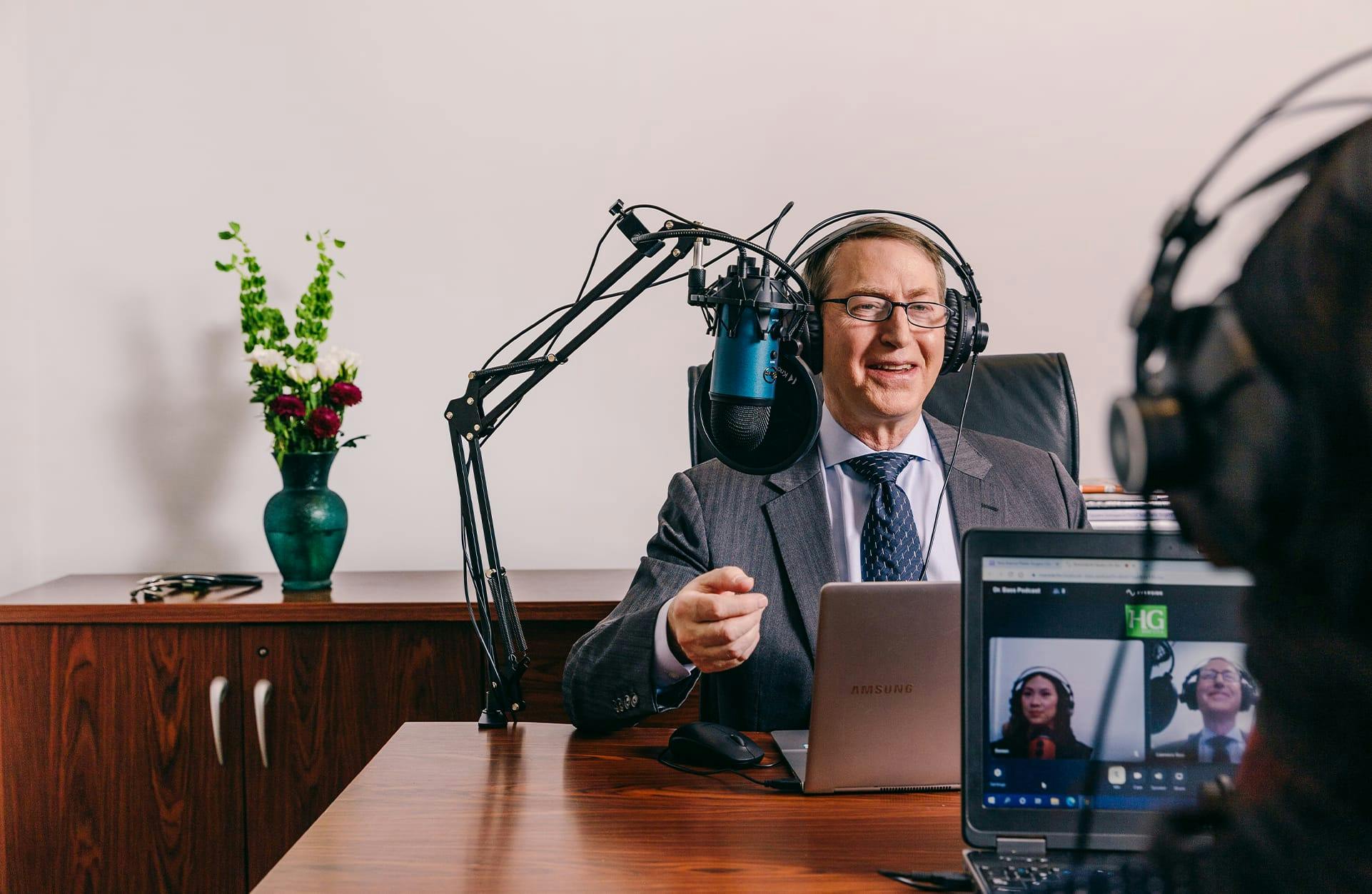
Dr. Lawrence Bass and Dr. Kylie Edinger team up to unpack the truth behind one of plastic surgery's most misunderstood procedures: the facelift. Can it really erase decades of aging, or give you features you never had? Find out what it can (and can't) do.
They also tackle the biggest myths about scars, recovery, and non-surgical alternatives like fillers and threads. Is a scarless facelift real? How long will you really be hiding out?
Find out what's fact, what's fantasy, and how to set expectations that lead to results you'll love without chasing the impossible.
Hear more episodes from our facelift series
Learn more about facelift surgery
About Dr. Kylie Edinger
Dr. Kylie Edinger is a plastic surgeon practicing in Bozeman, Montana. During the creation of this facelift series, she was training as an aesthetic plastic surgery fellow with Dr. Bass and a host of other world class plastic surgeons at Manhattan Eye, Ear, and Throat Hospital in New York City. Part of the prestigious Northwell Health program, this is one of the top aesthetic plastic surgery fellowships in the country. Dr. Edinger completed her plastic surgery residency at the University of Wisconsin.
Follow Dr. Edinger on Instagram @kylieedinger
About Dr. Lawrence Bass
Innovator. Industry veteran. In-demand Park Avenue board certified plastic surgeon, Dr. Lawrence Bass is a true master of his craft, not only in the OR but as an industry pioneer in the development and evaluation of new aesthetic technologies. With locations in both Manhattan (on Park Avenue between 62nd and 63rd Streets) and in Great Neck, Long Island, Dr. Bass has earned his reputation as the plastic surgeon for the most discerning patients in NYC and beyond.
To learn more, visit the Bass Plastic Surgery website or follow the team on Instagram @drbassnyc
Subscribe to the Park Avenue Plastic Surgery Class newsletter to be notified of new episodes & receive exclusive invitations, offers, and information from Dr. Bass.
Transcript
Summer Hardy (00:01):
Welcome to Park Avenue Plastic Surgery Class, the podcast where we explore controversies and breaking issues in plastic surgery. I'm your co-host, Summer Hardy, a clinical assistant at Bass Plastic Surgery in New York City. I'm excited to be here with Dr. Lawrence Bass, Park Avenue plastic surgeon, educator and technology innovator. Today's episode is Facelift Fantasies, another in our series about the facelift. What are we talking about in this episode, Dr. Bass?
Dr. Lawrence Bass (00:29):
Two things. Really, the topic for this episode is all those things that patients believe about the facelift that may not be true, as well as some of the things that are promoted about other treatments that wish they could do what a facelift does. Those are the two broad categories of things.
Summer Hardy (00:51):
So start us off with things patients believe about the facelift. What kinds of things are we talking about?
Dr. Lawrence Bass (00:57):
Well, things patients believe or hope the facelift will do that. It simply won't. That would be the first side of this category. The other side would be things that they believe about the facelift that just aren't true. Things they worry about but don't have to. And we covered some of these in our facelift fears episode, so I won't repeat those here.
Summer Hardy (01:21):
Okay, that makes sense to me. What are some examples of unrealistic hopes for the facelift?
Dr. Kylie Edinger (01:28):
One example is when patients have a very heavy neck with a lot of extra skin and fat, although these heavy necks will be significantly improved with the face and neck lift, patients really need to understand that they will not be completely reversed with surgery. Every patient has their own starting point in anatomy, and where they start will impact their final result and where they end up. If you didn't start with a tight neckline early in life, don't expect one after surgery.
Dr. Lawrence Bass (01:55):
This is an important reality check. I mean, as much as we'd like to make people absolutely as beautiful as they could be, and that's why we went into this field, that's what makes us happy, is making patients happy. We'd love to give you the best possible result, but I can't take a subway car full of people in the New York subway system and take those 50 people and turn them into supermodels. That's just realistically not what plastic surgery does. It takes aging changes and undoes them mostly, but not a hundred percent. We're re draping skin against the underlying bone structure. We're not breaking your bones and moving them. There is plastic surgery that does that, but that's not facelift surgery. So if you're trying to change your appearance and come to a place you never were in youth, that's not where a facelift is going to drive you. If you're trying to look more like you looked at a younger stage, that is where facelift surgery is going to drive you part of the way back to your fully youthful appearance. Most of the way. There are things we can do where we work on the chin or cheek implants that change your look a little bit that amplify your bone structure and enhance the results, but most of that is not part of where facelift goes.
Dr. Kylie Edinger (03:26):
Another example is scars. As much as we wish we could, we cannot perform scarless surgery. There will always be a scar. Plastic surgery does make the best scars in medicine, and we work very hard to hide those scars in natural transition points of the face and contours along the ear and within the hairline to hide them. But no scars are 100% invisible.
Dr. Lawrence Bass (03:49):
Absolutely. And great scars are plastic surgery's special skill, but that's not the same as no scars. So the ability to place many tiny stitches to create the best possible scar. And in addition, if a scar heals unfavorably, we have many options to chase scars today and try to improve them with gel bandages and topical scar applications that are used at home, but also with injected anti-inflammatory medicines. And there are several kinds of these as well as a variety of laser treatments to diminish inflammation in scars and to soften and flatten them and eventually blend the texture of the scar so it resembles the surrounding skin.
Summer Hardy (04:39):
What are other facelift fantasies we should consider?
Dr. Lawrence Bass (04:43):
Well, we talked about one particular example, the heavy neck. And as I said, there's no perfect result ever in plastic surgery, and that's very vexing because plastic surgeons are perfectionists and so are most of our patients. But we have to somehow learn to live with that. We expect most of the laity to be corrected, but this will vary from individual to individual based on your age, your skin type, and the quality of your skin, the degree of laxity and other factors. But it's never going to be a hundred percent. Many patients come in and pull on the skin of their face or they look in the mirror and pull on the skin and say, gee, if I can just look like this, I'd be happy. Facelift is not going to get you quite to the point that you can achieve simply by pulling on your skin with your fingers. This is very frustrating, but we never obtain that degree of red draping. And in fact, in the classic textbook on aesthetic plastic surgery that was written and edited by one, the professors who trained me, Thomas Reese, there's a picture of a lady looking in the mirror and pulling expressly to teach surgeons this point that we're not going to achieve that results surgically despite the fact that it's simple to do with her own fingers in your dressing room looking in the mirror.
Dr. Kylie Edinger (06:19):
By the same token, the durability of correction, while it is much greater for facelifts than any of the alternative non-surgical treatments, is still not forever and cannot be exactly predicted. The same factors that affect the degree of correction like your age skin type and quality and your starting degree of laxity also affect the durability of your correction. If you start with very loose, lax skin that is aged and damaged, you'll have a result that does not last as long as a younger patient who has preserved elasticity and skin quality, who is able to maintain and uphold their surgical results for longer.
Dr. Lawrence Bass (06:55):
So this is very much like what we discussed, that there is this variation. You're going to continued age aging never stops. However, you'll never look as bad as you did had you done nothing even 10 years later. You may have regained some or much of the laxity that you started out with right before the facelift, but had you not had a facelift, you would've had what you started with plus 10 years of aging. So the facelift benefit in that sense is a forever benefit, but at some point, the facelift, if you want to look, your best will need to be redone.
Summer Hardy (07:42):
Got it. Are there any others in this category?
Dr. Lawrence Bass (07:46):
Oh, there are some facelift fantasies related to recovery. Many patients have a fantasy about how long it will take for recovery, and sometimes that's very short with no interruption of activities, and they're not expecting to put a pause on some of their work or social activities to allow some healing time. And other patients have an image of facelift taking many, many months where you're simply not presentable, don't look like yourself and can't be out in public, and neither one of those are true.
Dr. Kylie Edinger (08:27):
A typical time course for recovery is generally a few days of rest and cool compresses one to two weeks out of view for routine work and socializing, three to four weeks for no strenuous heavy activity like exercising, and six weeks to three months for higher profile events like weddings. It takes three to six months to fully heal and scars to mature, but at this point, your activities are no longer limited. You just need to know that during this time, subtle swelling or firmness is settling and scars are continuing to fade. This of course, varies from person to person. Some patients have more swelling and bruising while others hardly have any, and there is no great way to predict this.
Dr. Lawrence Bass (09:06):
There are a lot of things we do in modern face lifting to help minimize the recovery time. Everyone has a busy schedule. It doesn't matter what your lifestyle is. In my marketplace in New York City, there are very few people who don't have things packed in their schedule. And finding the recovery time is part of the challenge of scheduling the facelift. So plastic surgeons have worked very hard to try to minimize that recovery time and to try to make it as predictable. In other words, try to make it match that time course that Dr. Edinger listed for us so that you don't get a surprise or an unexpected amount of recovery. And so plastic surgery has succeeded increasingly in doing that, but there is potentially some variation as Dr. Edinger pointed out in that recovery time. So you need to have a little bit of buffer zone, but you can most of the time pretty much plan on a time course that she outlined.
Summer Hardy (10:18):
Okay. Thanks for sharing fantasies that fall into that first category that centers around what patients believe or hope the facelift will do that it won't. Can we now talk about the other category of fantasies, the one relating to treatments that are trying to substitute for the facelift?
Dr. Lawrence Bass (10:34):
There are many treatments like this. I firmly believe there's an appropriate and valuable role for most aesthetic treatments, and when they're called on to solve problems in the appropriate patient at the right stage of aging, these treatments can be quite useful. However, in the setting where a facelift is appropriate, the alternatives in a best case scenario are a compromise giving you a fraction of the degree of improvement and the durability of improvement. And at worse, a lot of these alternatives are a complete waste of time or potentially could distort your appearance. And Dr. Edinger, I mean you've had patients coming in asking for a liquid facelift. Can you tell us what you explained to them about that?
Dr. Kylie Edinger (11:33):
I absolutely have, and it's always a challenging conversation, especially when patients come in with an ideal before they even walk in your door about they're hoping to achieve non-surgically. I have patients frequently inquire about liquid facelifts and other nonsurgical modalities to really improve jowling, skin laxity and tissue descent most commonly. I had a patient recently who came to see me who had a significant amount of jowling and skin laxity as well as a lot of tissue descent with loss of volume, a heavy neck and platysmal banding. She was convinced that she wanted a liquid facelift and she wasn't interested in discussing surgical correction. I explained to her that she wasn't a good candidate for a liquid facelift because the degree of skin laxity and volume loss she had was simply not amenable to correction with fillers. It would've been a waste of her money and it would've cost a significant amount of it that she would've had to spend on filler to hopelessly combat aging with an inappropriate modality.
(12:23):
The amount of fillers she would've needed to improve her skin laxity would've left her with grossly distorted and unnatural features. She really needed surgery to fix the issues that were bothersome to her. I always try to be very honest with patients about what will and will not give them the results they desire. And sometimes that means telling them what they don't want to hear, including not being a candidate for a nonsurgical modality that will not get them the results they're hoping for. If I think a liquid facelift is appropriate and will help a patient, I am more than willing to offer that service as long as they have realistic expectations and an understanding of its limitations. But if a patient's a poor candidate for these procedures, then I think we owe it to the patients to be honest about that, even if it's not the answer they we're hoping to hear.
Dr. Lawrence Bass (13:06):
And I'm not wild about the term liquid facelift, even though I brought it up here because it's really not a facelift. It's a volume restoration, and I inject volume in people's faces every day. I'm not against doing that. It's a critical part of anti-aging treatment at almost every stage of aging from just starting to age in your thirties to late stages of aging in your eighties, seventies. So I'm not against that putting back volume to the extent you lost. It is probably a good idea, but trying to tailor laxity out of the skin in excess of that distort your appearance. And the other important point about that is in the neck area, there is no role for volume injected filler to restore the neck. Energy treatments may, early in the aging, take a little bit of laxity out in the neck, and that may be all you need at that point, but filler or volume, if the aesthetic issue you're looking at and concerned with is in the neck, is simply not one of the solutions, whether that change is mild or that change is substantial.
(14:34):
Now, the term facelift, like the liquid facelift has been applied to many things that are in no way a facelift. In essence. Other treatments and products are stealing the name facelift because it's the gold standard for facial rejuvenation. Most of these things are not surgery and either don't address the same features or don't work in the same fashion. So the liquid facelift is, or filler facelift is one example. And some people are pumping so much filler in their faces to tailor out skin laxity, they're grossly distorting their facial shape and general appearance. And we can all name a celebrity or two who's done this and taken what was a beautiful, gorgeous face and really ruined it. Thread treatments or suture lifts. Also say they're a non-surgical facelift, and there are many energy devices marketed as a non-surgical facelift. And some of these non-surgical lifters have specific FDA approvals for lifting and are an appropriate treatment at an early stage of aging or maybe to tailor out a little early recurrence of laxity after a facelift. But others are just general energy delivery systems for tissue heating that may help with some features of skin quality but have no demonstrated potential for skin lifting. And another whole category that uses the facelift term, and I see this every night during the evening news, during the commercials are skin products, creams and lotions marketed as a non-surgical facelift.
Summer Hardy (16:30):
I know we discussed this in an earlier episode in this series, but can you remind us what a facelift does Dr. Edinger?
Dr. Kylie Edinger (16:36):
Absolutely. Very briefly, a facelift adjusts the skin to pull out laxity and tighten the deeper connected tissues and muscles of the face and neck to restore a youthful position and configuration. Facelifts address both the skin laxity and the tissue descent that alter the shape of the face as we age.
Dr. Lawrence Bass (16:54):
When you understand what facelifts do and how they accomplish this, it becomes clearer why there's no nonsurgical facelift. For example, liquid facelifts fill tissues out, they increase projection, fill in depressions, contour depressions, or amplify contour convexes, but they have little ability to suspend tissue or lift them, and it's so if we can leave you with one message, it's that there is no such thing as a non-surgical facelift in existence now. If there was, it would not be a secret. It might be very expensive, but it would be widely available. There are things that can help very early with laxity, and there are things that can help with volume restoration, which is a separate aging change, but there is nothing that currently can replace the degree of improvement or durability of improvement of the surgical facelift, neck lift. And not only that, but I'm very involved in looking at and helping develop new technologies, both device-based treatments and bio technologies.
(18:15):
And from what I've seen, what I've heard companies talking about, there's nothing on the horizon in the next five or 10 years that will be a substitute for the facelift. And so if you're on the cusp of needing a facelift, you are extremely unlikely to have another meaningful substitute. That doesn't mean you can't do things to help slow down aging or make minor corrections, but to really chase the types of facial aging that facelift corrects, there's currently no other option, and there's no foreseeable option. If you're 25 years old, I tell you, stay tuned. Who knows what may come by the time you need a big correction. But for folks on the verge of needing a facelift, you'll need to make the decision to go ahead with a facelift or to let aging have its way with you. As I've said many times on this podcast, either decision is okay, but you have to accept the good and bad aspects of either of those decisions in a realistic way.
Summer Hardy (19:20):
Thank you for that refresher on what facelifts do. Dr. Edinger, do you have any takeaways to share with our listeners?
Dr. Kylie Edinger (19:27):
I think the best place to start with dispelling fantasies and understanding the limitations and applications of surgical and non-surgical modalities is to meet with a trained plastic surgeon. There are so many things on the internet and so many people offering treatments for skin laxity and volume loss and so many miracles out there that can be really overwhelming for patients. The best thing to do is just speak with an expert to find out what treatments you are a candidate for and which ones will give you the results you're hoping for. Some patients want to avoid surgery and that's okay, that's their decision. But speaking with a board certified plastic surgeon is a way that you can express your desires and get honest answers and solutions to the issues that bother you so that you can make the best decision for yourself.
Summer Hardy (20:12):
And Dr. Bass, would you give us your takeaways?
Dr. Lawrence Bass (20:15):
So fantasies speak to our emotional wants and needs and to our anxieties. Unfortunately, they provide little support at the end of the day because they won't occur in real life, only in our imagination. Having realistic expectations of the facelift is key to fulfilling our hopes and dreams in the best way possible in the real world, and that's never a hundred percent correction. That's a fantasy. It's never perfect symmetry. That's a fantasy. There's no symmetric human. There's no meaningful substitute for what a facelift can provide in terms of treating laxity and restoring a youthful facial shape. Everyone has to accept the presence of permanent scars, but these are minimally visible in almost all cases once the healing is complete.
Summer Hardy (21:14):
Thank you, Dr. Edinger and Dr. Bass. Debunking myths is definitely part of our goals here on the podcast, and your discussion of facelift fantasies has certainly done a great job getting at a bunch of them. Thank you for listening to the Park Avenue Plastic Surgery Class podcast. Follow us on Apple Podcasts, write a review and share the show with your friends. Be sure to join us next time to avoid missing all the great content that is coming your way. If you want to contact us with comments or questions, we'd love to hear from you. Send us an email at [email protected] or DM us on Instagram @drbassnyc.